 |
Home | Services | Store | Downloads | Articles | Help | |
|
Recommended Books & Products In association with our trusted partners Amazon and High Point Scientific |
||
|
Skymaps.com/store -- Recommended Books & Products for Skywatchers |
|
New Books •
Star Atlases •
Planispheres •
Getting Started •
Observing Guides •
Telescope Books •
Kids Books •
Sky Myths
Almanacs • History & Artistry • Star Map Prints • AstroPhotography • Telescopes & Binoculars • Media • Astro Calendars |
| As an Amazon & HPS affiliate we earn a small commission (at no extra cost to you) from qualifying purchases |
 |
|
Help Support The Evening Sky Map The Evening Sky Map is designed to help all sky watchers to discover the wonders of the night sky. Monthly editions for Northern, Southern and Equatorial latitudes make The Evening Sky Map a unique resource for users worldwide. Please consider supporting this free service by making a donation or by purchasing recommended products. Thank you. |
| ||
| Category >> | Getting Started in Sky Watching | |
| There's no better way to learn about skywatching and the night sky than with a good book. | ||
|

|
Nightwatch -- New 5th Edition (2023) A Practical Guide to Viewing the Universe by Terence Dickinson (Author), Ken Hewitt-White (Author), Richard Tresch Fienberg (Foreword) 208 pages, 5th Edition, September 2023. Revised 5th Edition updated for use through 2035. Level: Beginner to Intermediate Highly Recommended List Price: Amazon Price: Click Here & Save Average customer rating:  More info (Concealed Wiro-Bound Hardcover): click here  Also available at: Amazon.co.uk (UK) Stargazing enthusiasts of all levels of experience will discover much of value in an enduring reference conceived by one of the most respected names in amateur astronomy. This must-have Fifth Edition includes:
Much has happened in this popular hobby since the revised Fourth Edition of NightWatch was published in 2006. In response, the text has been substantially revised and updated throughout all 13 chapters. Moreover, the book has been completely redesigned and most of its many photographs have been replaced. A noted feature is the variety of superb astrophotos of star clusters, nebulas, galaxies and other celestial phenomena taken by accomplished amateur astronomers. Lavishly illustrated sections on the Moon and planets will inspire novice observers of the solar system. To accommodate the extensive revisions, NightWatch has grown from 192 pages to 208 pages. With the release of the Fifth Edition, we are also launching a new website, NightWatchBook.com, that will offer links to additional resources and will be regularly updated with information on new celestial events and equipment. Since the First Edition of NightWatch was released in 1983, the most significant transformations in amateur astronomy have been in optics and technology. For all the latest on gadgets and gear, renowned astrophotographer Alan Dyer, Dickinson's coauthor of The Backyard Astronomer's Guide, has contributed an entirely new chapter on basic digital astrophotography. Dyer has also modernized a key portion of an enlarged chapter on stargazing equipment, creating a welcoming place in NightWatch for today's computerized telescopes.
Amazon.com Customer Comment (previous edition): |
|
| ||
|
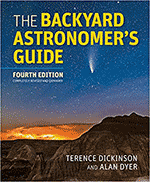
The Backyard Astronomer's Guide by Terence Dickinson (author), Alan Dyer (author), and Sara Seager (foreword) 416 pages, 4th Edition, September 2021 Level: Beginner to Intermediate Highly Recommended
List Price:
More info (Hardcover): click here Technology and astronomical understanding are evolving at a breathtaking clip, and to reflect the latest information about observing techniques and equipment, this massively revised and expanded edition has been completely rebuilt (an additional 48 pages brings the page count to 416). Illustrated throughout with all-new photographs and star charts, this edition boasts a refreshed design and features five brand-new chapters, including three essential essays on binocular, telescope and Moon tours by renowned astronomy writer Ken Hewitt-White. With new content on naked-eye sky sights, LED lighting technology, WiFi-enabled telescopes and the latest advances in binoculars, telescopes and other astronomical gear, the fourth edition of The Backyard Astronomer's Guide is sure to become an indispensable reference for all levels of stargazers. New techniques for observing the Sun, the Moon and solar and lunar eclipses are an especially timely addition, given the upcoming solar eclipses in 2023 and 2024. Rounding out these impressive offerings are new sections on dark sky reserves, astro-tourism, modern astrophotography and cellphone astrophotography, making this book an enduring must-have guide for anyone looking to improve his or her astronomical viewing experience. The Backyard Astronomer's Guide also features a foreword by Dr. Sara Seager, a Canadian-American astrophysicist and planetary scientist at the Massachusetts Institute of Technology and an internationally recognized expert in the search for exoplanets.
Amazon.com Customer Comment: |
|
| ||

|
National Geographic Stargazer's Atlas The Ultimate Guide to the Night Sky by Andrew Fazekas and National Geographic 432 pages, October 2022 Level: All
List Price: Combining science, exploration, and storytelling, National Geographic Stargazer's Atlas invites readers to roam the night sky for constellations, planets and moons, eclipses, comets and meteor showers, auroras, and deep-sky treasures including nebulae and galaxies?many visible to the naked eye and all with binoculars or a backyard telescope. Beginning with basic space science and including a complete set of night sky maps for all four seasons in the Northern and Southern Hemispheres, this fascinating book guides the reader toward the most rewarding observations. A unique chapter on astrotourism highlights ancient observatories, dark-sky preserves, and other global destinations for the sky-seeking traveler; a final chapter details current and future space missions and what they might discover. Richly illustrated with awe-inspiring imagery including photos from space missions and telescopes, science-based artists' interpretations, and explanatory graphics the book also contains 170 maps and charts of planets, moons, and constellations, from Earth's moon to moons of Saturn. Practical advice throughout helps readers see what they have been reading about, building key observational skills such as "star hopping" from easy-to-find stars to fainter deep-sky objects and focusing on "deep sky treasures" areas rich in observable phenomena. Approachable and authoritative, gorgeous and fascinating, National Geographic Stargazer's Atlas will intrigue all who love to gaze up in wonder at the night sky and find themselves wanting to know more.
Amazon.com Customer Comment: |
|
| ||

|
The Total Skywatcher's Manual Skills and Tricks for Exploring Stars, Planets, and Beyond by the Astronomical Society of the Pacific 272 pages, February 2019 Level: Beginner
List Price: With fully illustrated star charts, gorgeous astrophotography and step-by-step project instruction, this family friendly book is the only guide you'll ever need to navigate the nightsky. Learn about the phases of the moon, how to conduct your own deep-sky observations, how the universe is expanding, our search for life on other planets, meteors vs. meteorites, sunspots and solar flares, best eclipse-viewing techniques -- everything you need to know to appreciate the wonder of our universe. Based in San Francisco, the Astronomical Society of the Pacific has a 125-year history of providing resources, tools, and information to astronomy enthusiasts, including amateur astronomers, families, and science educators (K-16). Join the ASP on this journey through the nightsky and beyond.
Amazon.com Customer Comment: |
|
| ||

|
50 Things to See with a Telescope A Young Stargazer's Guide by John A. Read 72 pages, August 2018 Level: Beginner
List Price: About the Author: John A. Read volunteered at hundreds of stargazing events as a member of the Mount Diablo Astronomical Society in California, teaching people of all ages how to use a telescope and find objects in the sky. John is a telescope at the Burke-Gaffney Observatory and a board member at the Halifax Centre of the Royal Astronomical Society of Canada. He lives in Halifax, Nova Scotia.
Amazon.com Customer Comment: |
|
| ||

|
The Stars A New Way to See Them by Hans Augusto Rey 160 pages, December 2016 Level: Beginner Highly Recommended
List Price: This updated version includes revised facts and figures for planets, and new scientific information has been added. Charts indicate planet locations through the year 2026 and a website for finding locations well into the twenty-first century has been provided.
Amazon.com Customer Comment: |
|
| ||

|
365 Starry Nights An Introduction to Astronomy for Every Night of the Year by Chet Raymo 240 pages, January 1990. Reissue Edition. Level: Beginner Highly Recommended
List Price: This simple yet substantial text is full of critical information and helpful hints on how to observe the stars; describe their position; calculate their age, brightness, and distance; and much more. Whether you observe the sky with a telescope or the unaided eye, 365 Starry Nights makes the infinite intimate and brings the heavens within your grasp. Keep this invaluable, informative guide close at hand, and you'll find that the sky is the limit 365 nights a year.
Amazon.com Customer Comment: |
|
| ||

|
Constellations of the Northern Skies National Audubon Society Pocket Guides by Gary Mechler, Mark R. Chartrand and Wil Tirion (illustrator) 192 pages, April 1995 Level: Beginner
List Price:
Amazon.com Customer Comment: |
|
| ||

|
Astronomy: A Self-Teaching Guide by Dinah L. Moché 388 pages, 8th Edition, July 2014 Level: Beginner
List Price:
Amazon.com Customer Comment: |
|
|

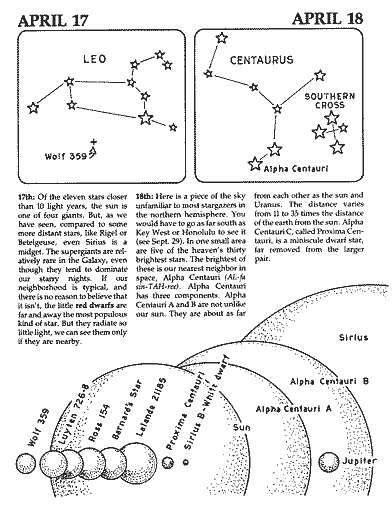
 Visually rich information and advice for stargazers.

|
Skymaps.com/store -- Recommended Books & Products for Skywatchers |
|
New Books •
Star Atlases •
Planispheres •
Getting Started •
Observing Guides •
Telescope Books •
Kids Books •
Sky Myths
Almanacs • History & Artistry • Star Map Prints • AstroPhotography • Telescopes & Binoculars • Media • Astro Calendars |
|
 |
HOW TO ORDER: Step 1: Click item's Buy from Amazon link (opens a new window). Step 2: Click the "Add to Shopping Cart" button. Do this before browsing. Step 3: Repeat Steps 1 & 2 to add more items to same shopping cart. Step 4: Click the "Proceed to Checkout" button to complete the purchase. |
Copyright - Terms of Use - Privacy Policy - Contact Us Copyright © 2000-2022 Kym Thalassoudis. All Rights Reserved. |
|
Helpful Pages for Amazon.com Customers Payment Methods • Shipping & Delivery • Guarantee Protection • Returns Policy |